
Choosing between open and keyhole release starts with confirming that the median nerve is actually compressed at the wrist. You will be able to compare the two access routes, judge when surgery is justified, understand recovery restrictions, and ask a surgeon whether the technique offered suits your anatomy and diagnosis.
Key takeaways
- Confirm median-nerve compression with examination and nerve conduction testing.
- Choose release when symptoms persist, weakness develops, or nerve damage is progressing.
- Open and keyhole surgery both divide the transverse carpal ligament.
- Compare recovery, pillar pain, scar concerns, complications, and surgeon experience.
Which symptoms and tests confirm carpal tunnel syndrome?
Numbness or tingling in the thumb, index finger, middle finger, and thumb-side of the ring finger fits median-nerve compression at the wrist. Night waking, dropping objects, weak thumb opposition, or wasting of the thenar muscle strengthens that suspicion. Wrist pain alone does not justify carpal tunnel release in thane.
Examination checks sensation, thumb strength, thenar bulk, grip, provocative wrist tests, neck movement, and other nerves. A proper preoperative assessment may include:
| Test | What it shows | Why it matters |
|---|---|---|
| Nerve-conduction study | Slowed median-nerve signals across the wrist | Supports diagnosis and grades severity |
| Electromyography | Electrical evidence of nerve or muscle damage | Detects axonal loss, cervical radiculopathy, or another nerve lesion |
| Ultrasound | Median-nerve enlargement or a mass inside the tunnel | Helps when findings are atypical or a structural cause is suspected |
| Clinical examination | Symptom distribution, weakness, wasting, and competing causes | Determines whether testing matches the symptoms |
A normal nerve-conduction study does not always exclude clinically suspected carpal tunnel syndrome, especially when symptoms are intermittent or mild. Testing becomes particularly valuable before surgery, with severe or recurrent symptoms, or when another diagnosis is possible.
Ask for further investigation when symptoms involve the little finger, the whole hand, or both sides diffusely; when neck pain radiates into the arm; or when arthritis, tendon disorders, infection, a mass lesion, diabetes-related or generalised neuropathy, cervical radiculopathy, or another source of hand pain could explain the problem.
When is release preferable to splinting, injections, or continued observation?
Move to decompression when symptoms persist despite a properly fitted night splint, activity changes, ergonomic adjustments, hand therapy, or a corticosteroid injection. An injection can reduce symptoms for weeks or months, but it is not a durable substitute for ligament release in many patients.
| Option | What it does | When it stops being enough |
|---|---|---|
| Night splint | Holds the wrist neutral during sleep | Night waking or daytime numbness continues |
| Activity and ergonomic changes | Reduce prolonged bending, gripping, and vibration | Symptoms remain despite changing the trigger |
| Hand therapy | Addresses tendon movement, posture, and function | Weakness or sensory loss progresses |
| Corticosteroid injection | Offers short-term symptom relief | Symptoms recur or nerve testing shows severe compression |
Stronger reasons to operate include:
- Persistent night or activity-related numbness and tingling
- Difficulty buttoning clothes, handling tools, or dropping objects
- Weak thumb opposition or visible thenar muscle wasting
- Severe abnormalities on nerve-conduction studies
- Symptoms that continue after appropriate non-surgical treatment
Do not wait through worsening weakness, constant numbness, or thenar wasting without review. Surgery removes pressure from the median nerve, but it cannot reliably reverse longstanding axonal loss; night tingling often improves earlier than constant numbness or muscle weakness.
Diabetes, thyroid disease, inflammatory arthritis, pregnancy-related fluid changes, obesity, and smoking can affect symptoms, wound healing, nerve recovery, or recurrence. Treating these factors helps, but established mechanical compression can still require release. Discuss the timing of carpal tunnel surgery in Thane with a surgeon after examination and indicated testing.
Open versus keyhole release: what actually changes?
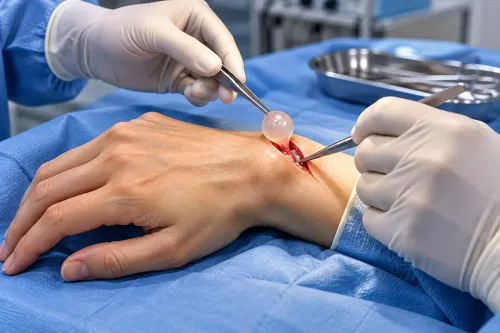
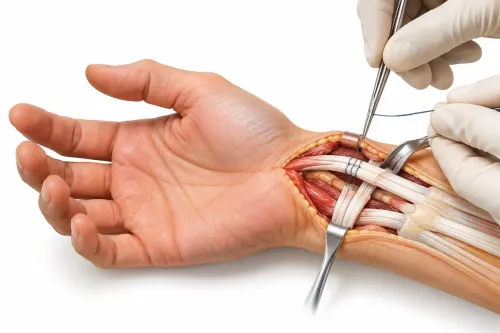
Open release and keyhole release divide the same transverse carpal ligament. The difference is the route: open surgery uses a palmar incision for direct access, while endoscopic release uses an endoscope through one or two small portals.
| Feature | Open release | Endoscopic or keyhole release |
|---|---|---|
| Surgical view | Broad, direct view of the ligament and nearby anatomy | View through an endoscope with a narrower field |
| Instruments | Standard surgical instruments through the palmar incision | Endoscope and specialised cutting instruments |
| Incision | Larger incision in the palm | One or two smaller incisions near the wrist or palm |
| Anaesthesia | Usually local anaesthesia as an ambulatory procedure | Usually local anaesthesia as an ambulatory procedure |
| Potential advantage | Established technique and broader exposure | Less early scar tenderness and earlier return to some activities |
| Main trade-off | More early palmar wound or scar tenderness | Learning-curve risks, including incomplete release or injury to a nerve or vessel |
“Keyhole carpal tunnel surgery” usually means endoscopic release, but ask exactly which minimally invasive method is offered. Regional or general anaesthesia may be selected when appropriate for you, the surgeon, and the facility; keyhole does not mean injection-free surgery.
Endoscopy is not automatically suitable after previous wrist trauma or surgery, deformity, inflammatory disease, recurrent compression, unusual anatomy, or extensive scarring. If the view is inadequate or the ligament is not fully divided, the surgeon may convert to open surgery.
Long-term symptom and nerve-function results are generally similar, so choose the access route—not the smaller scar alone—with your carpal tunnel surgeon in Thane.
What recovery, pain, and complications should you compare?
A smaller incision does not guarantee an easier recovery. After either carpal tunnel release in Thane, protect the wound, move your fingers early, and increase loading only when tenderness and symptoms allow.
| Milestone | Open release | Endoscopic or keyhole release |
|---|---|---|
| Dressing and wound care | Keep dressing clean and dry; change it as instructed | The same; a small portal still needs protection |
| Finger movement | Begin gentle finger movement early | Begin gentle finger movement early |
| Driving | Resume when you can grip and steer safely without sedating pain medicine | The same |
| Keyboard work | Restart when typing does not increase pain or swelling | Some people manage it sooner, but comfort decides |
| Lifting and manual work | Progress gradually; delay heavy gripping and forceful wrist loading | The same restrictions apply |
| Grip strength and sport | Build strength after wound tenderness settles; return to sport when grip and wrist loading are comfortable | Earlier activity is possible for some, not guaranteed |
Open release can cause pillar pain and heel-of-palm tenderness when gripping or pushing up from a chair. Scar sensitivity can trouble drivers, manual workers, or people using walking aids. Endoscopic release avoids a larger palmar incision but carries risks of nerve, nerve-branch, or vessel injury and incomplete ligament division.
Both techniques can cause stiffness, infection, persistent symptoms, or recurrence, while long-term symptom and nerve-function results are often similar.
Night tingling may improve early; constant numbness, weakness, or thenar wasting can recover slowly or incompletely after longstanding compression. Ask during a carpal tunnel surgery in Thane consultation how your operated hand and job demands change the timetable, rather than choosing by the label “keyhole.”
How should you choose a carpal tunnel surgeon and technique in Thane?
Choose a carpal tunnel surgeon in Thane by verifying experience, diagnosis, technique, and follow-up—not by incision size. “Keyhole carpal tunnel surgery in Thane” is a search phrase, not proof that endoscopic release is safer or better.
Ask directly whether the surgeon regularly performs endoscopic release, open release, or both, and what anaesthesia and pain plan the facility uses.
| Open release | Endoscopic release |
|---|---|
| Palmar incision with direct surgical view | One or two small portals using an endoscope |
| Divides the transverse carpal ligament | Divides the same ligament through a different access route |
| Established exposure for unusual anatomy or scarring | Smaller access route, with a learning curve and possible conversion to open surgery |
Take this checklist to your consultation:
- What training and regular experience do you have with hand and wrist decompression?
- How has the diagnosis been confirmed, and is nerve-conduction testing indicated?
- Why does this access route suit my examination, anatomy, work, and previous surgery?
- How will you manage unusual anatomy, scarring, or incomplete ligament release?
- Which complications and their rates will you cover during consent?
- Could you convert to open surgery if the view is inadequate?
- Who reviews the wound, and when?
- What follow-up is available if numbness or weakness persists?
Ankur Hospital - Dr. Amol A. Gharote can be one local option for discussing diagnosis, technique, anaesthesia, and follow-up; the facility’s availability of endoscopic release must still be confirmed directly.
Related service
Carpal Tunnel Release Dr. Amol Gharote is a skilled Orthopedic Surgeon at Ankur Hospital, Thane East, providing expert diagnosis and treatment for carpal tunnel syndrome. View service → |
Frequently asked questions
Which symptoms and tests confirm carpal tunnel syndrome?
Numbness in the thumb, index, middle, and thumb-side of the ring finger supports the diagnosis. Night waking, dropping objects, weak thumb opposition, or thenar wasting strengthen it. A clinical examination and nerve conduction study help confirm median-nerve compression and its severity.
When is carpal tunnel release preferable to splinting, injections, or observation?
Release becomes more appropriate when symptoms persist despite night splinting, recur after injection, or include constant numbness, weakness, thenar wasting, or abnormal nerve testing. Mild, intermittent symptoms can be observed or treated without surgery.
What changes between open and keyhole carpal tunnel release?
Both operations cut the transverse carpal ligament to decompress the median nerve. Open surgery uses a larger palm incision; keyhole or endoscopic surgery uses smaller incisions and a camera. The choice affects incision size, visual access, equipment, and surgeon experience more than the goal of treatment.
What recovery, pain, and complications should you compare?
Compare wound care, time away from gripping work, scar tenderness, pillar pain, grip recovery, infection, nerve injury, incomplete release, and recurrence. Follow-up timing and hand therapy depend on your symptoms, work, examination, and surgical findings.
How should you choose a carpal tunnel surgeon and technique in Thane?
Ask about the surgeon’s training in hand surgery, experience with open and keyhole release, diagnostic evidence, expected recovery, complication plan, and follow-up. Choose the technique that matches your nerve findings, health, work demands, and the surgeon’s established expertise.
Keywords