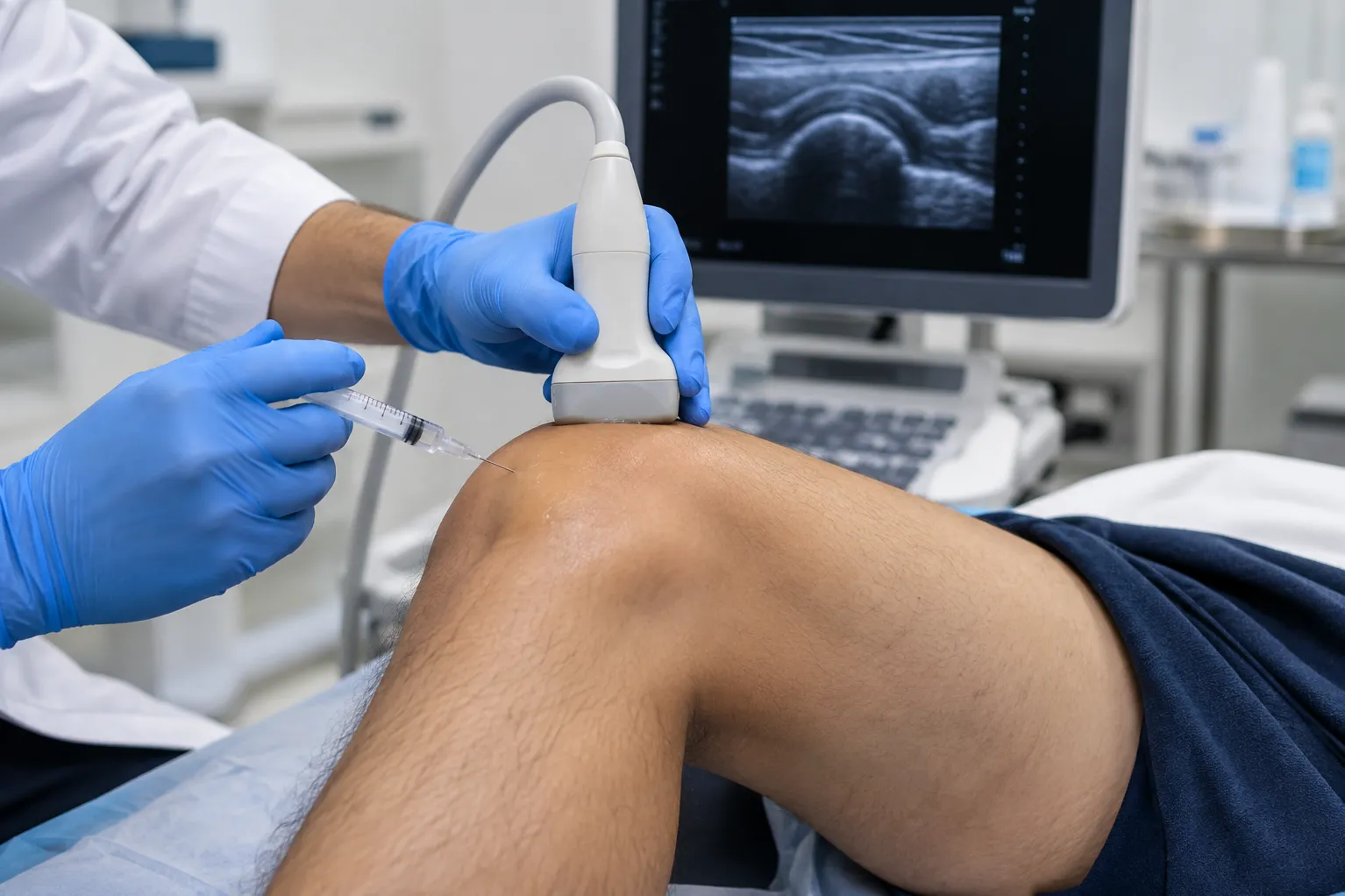
Injection therapy is used in selected musculoskeletal conditions to deliver medication to a particular joint, tendon sheath, bursa, or other anatomical structure. One approach increasingly used in orthopaedic practice is USG guided injection therapy, where ultrasound imaging helps the clinician visualise the target area while performing the injection.
The main difference from a conventional landmark-based injection is the use of real-time imaging to guide needle placement.
How Does Ultrasound Guidance Work?
Ultrasound produces live images of soft tissues and other structures beneath the skin. During an ultrasound-guided procedure, the clinician can identify the intended target and observe the needle as it advances.
This can be particularly useful when the treatment area is small, deep, close to important structures, or difficult to locate accurately through surface landmarks alone.
How Does It Compare With Landmark-Based Injection?
Traditional injections use anatomical knowledge and external landmarks to determine the injection site. These remain appropriate for various clinical situations.
Ultrasound guidance adds visualisation. Depending on the condition and anatomical site, this may help the clinician:
- Identify the intended structure
- Observe needle positioning
- Avoid certain surrounding structures
- Confirm delivery at the selected location
- Assess some soft-tissue abnormalities during the procedure
However, ultrasound guidance does not mean that an injection is automatically necessary or that it will resolve every painful condition.
Which Problems May Be Considered?
Depending on diagnosis and clinical judgement, image-guided injections may be considered for selected joint, tendon, bursal, or soft-tissue problems.
The first step is still diagnosis. Injecting an area simply because it hurts can miss the actual source of symptoms.
Questions Patients Should Ask
Before undergoing injection therapy, it is reasonable to understand:
- What is the diagnosis?
- What medication is being proposed?
- Why is an injection being considered?
- Why is ultrasound guidance useful in this case?
- What are the possible risks and limitations?
- What activity or rehabilitation is recommended afterward?
Patients should also provide their clinician with information about medicines, allergies, diabetes, anticoagulant use, previous injections, and relevant medical conditions.
In Thane, where patients have access to multiple orthopaedic treatment choices, understanding the reason behind a procedure is more useful than selecting treatment based solely on technology.
At Ankur Hospital, Dr. Amol A. Gharote considers clinical findings and the underlying musculoskeletal condition when evaluating whether USG guided injection therapy is appropriate.
Ultrasound guidance can add precision to selected injection procedures, but it remains one component of a broader treatment plan. The best approach begins with an accurate diagnosis, appropriate patient selection, and a clear understanding of what the injection is intended to achieve.
Keywords